Saturday, November 26, 2016

The Mistletoe Secret by Richard Paul Evans

Dear Universe,
Is anyone out there?

Thinking no one is reading, a blogger who calls herself LBH writes about her most personal feelings, especially her overwhelming loneliness. She goes from day to day showing a brave face to the world while inside she longs to know how it would feel if one person cared about her.

Alex Bartlett cares. He’s reading her posts in Daytona Beach, Florida. Nursing his own broken heart and trust issues, he finds himself falling for this sensitive, vulnerable woman whose feelings mirror his own. Following a trail of clues LBH has inadvertently revealed, he discovers that she lives in the small town of Midway, Utah. He makes his way there just after Thanksgiving, determined to find LBH. Maybe she’s a Lisa, Lori, or a Luanne. Instead, he finds a woman named Aria, a waitress at the Mistletoe Diner, who encourages Alex in his search while serving his pie along with some much-needed sympathy and companionship.

Alex finally finds his LBH, a woman who is as beautiful and kind as he imagined she would be. How can he tell her that he knows her secret? What’s holding him back? Could it be his feelings for Aria?
 

Publised November 15, 2016 by Simon & Schuster

My Review: This is Mr. Evan's third book with Mistletoe in the title, but these books are not a series. They are books about people being hurt and needing to find true love, although with hurdles along the paths they walk.

I find it interesting to find a guy who can write such wonderful, clean heartfelt romance books. My experience shows that guys just do not get the romance stuff, even if it is something as simple as pulling off the side of the road to pick wildflowers. That being said, I did enjoy this book.

Mr. Evan's writing pulled me right into the situations going on. I feel like a silent person within the story, sitting off a short distance away watching and feeling the highs and lows the characters go through. 

Mr. Evan's has written another great romance centered around the Christmas season. I recommend turning on the Christmas tree lights, getting comfy with a cozy blanket wrapped around you, and start reading.

I give it four and three-quarters Paws Up. I did not give it a full five, because I throughly enjoyed his The Mistletoe Inn even better. (I use "Paws Up" instead of stars or thumbs up for my rating scale. Five Paws Up is the best rating.) 


Saturday, November 12, 2016

A Baxter Family Christmas by Karen Kingsbury

Two sorrowful years have passed since the terrible car accident that took the life of John Baxter's daughter, Erin, along with her husband and three of their four daughters. But this year John has invited a stranger for dinner - Kendra Bryant, the transplant recipient who now has Erin's heart.

In light of her father's idea, Ashley and her brother Luke don't think it's right. They want to protect their ten-year-old niece, Amy - the only surviving member of the accident. But John is determined and believes meeting this woman is something his deceased daughter would want.

At the same time, Maddie West, the eighteen-year-old daughter of Brooke Baxter West, is praying for meaning this Christmas. Could she find it in a newfound friendship with a boy she never expected to see again? Maddie believes in miracles, especially at Christmastime, but this is a stretch even she can't imagine.

Meanwhile, Kendra Bryant has been struggling these past few years to find meaning in the tragedy that gave her a second chance. She believes this invitation to see the Baxters and witness their unwavering faith in God can instill hope and happiness back into her life.

Heartwarming and touching, filled with love and hope, A Baxter Family Christmas brings together two families in the aftermath of a tragedy and in the midst of an unfolding love story, all with the help of one very special child.


Publisher:  Published October 25th 2016 by Howard Books

My Review:  I have not read any of Karen Kingsbury books before, so I have no history to rely on for the Baxter family, who have appeared in multiple books. Despite this, Karen provides a section, at the beginning of the book called The Baxter Family Yesterday and Today. This helps a new comer to learn about the characters. I had to refer to this section several times while reading the first four chapters to get the characters sorted out, so that I could eventually follow along.

My only complaint is with chapters five and six. It is Thanksgiving day with two families celebrating Thanksgiving. Both families live in Bloomington, Indiana. With one family the weather is in the high 60's, temperture wise. Later in the evening with the other family, one character is looking at the snowy backyard. Living in Indiana, I am well aware of how quickly the snow can melt in high 60 degree weather; plus it is unusual for there to be much snow at this time of the year, especially in Bloomington. This is an inconsistency that should have been caught and I fixed during editing.

Karen's writing pulls you right into the book, allowing you to enjoyed getting to know the Baxter and Flanigan families during the holidays. You, also, learn about the sensitive subject of organ donors, the person who died, the recipient of the organ(s), and how it affects the families involved. 

Turn on the Christmas lights, snuggle under a nice blanket, and read this book. I give it Four and a Half Paws Up.  (I use "Paws Up" instead of stars or thumbs up for my rating scale. Five Paws Up is the best rating.)

Saturday, October 29, 2016

How To Charm a Beekeeper's Heart by Candice Sue Patterson

Weddings are the last thing beekeeper Huck Anderson wants to be associated with, considering his past. So when he inherits a building occupied by a bridal boutique, he aims to evict the failing business and open a sporting goods store. Until his tenant ends up being Arianne Winters, a woman he’s indebted to from a mistake made years ago. 

When a life-threatening injury derails Huck entirely, Arianne offers a compromise to keep her boutique, and her life, out of bankruptcy—she’ll aid in his lengthy recovery if he’ll allow her to remain in his building. But nursing her adversary proves challenging when her adolescent crush resurfaces. 

Amidst a battle-of-wills, their lives intertwine in unexpected ways, providing opportunity to overcome their pasts and start anew. Will this confirmed bachelor consider holy-matrimony, or will Huck’s choices sting them a second time?

Publisher: White Rose Publishing 2016

My Review: I was privileged to read this book prior to it being published. As I am working to be a beekeeper, I loved the honeybee facts at the beginning of each chapter.

I was drawn into the story quickly, and thoroughly enjoyed it. Candice is able to "paint a scene" with her words, so the reader is able to create a movie in their mind. The hero and heroine are realistic; and you will easily be able to identify with their lives. In addition, you will fall in love with Arianne's little girl - Emma, who chips away at the wall in front of Huck's heart.

Find a comfortable reading spot, settle down, and enjoy this book. You will not be disappointed. I give it Five Paws Up.  
(I use "Paws Up" instead of stars or thumbs up for my rating scale. Five Paws Up is the best rating.)

Saturday, October 15, 2016

Organic Peanut Butter Helps With Dog's Nail Trimming


Organic Peanut Butter
on a Spoon.
Paws 4 Hearts Photo 2016
I wouldn't think that a 7.6 pound dog would be able to keep humans fifteen times or more bigger than her from trimming her nails, but Spritzen Nala O'Chi is able to do it. For me, I know how stress can be detrimental on an animal's health. Stress can cause an animal to have a stroke, and this was always on my mind as Spritzen Nala struggled and fought against having her nails trimmed.

Spritzer Nala has white nails, which makes trimming easier, because I can see the pink quick, and avoid it. When a dog is struggling, kicking, crying, and flipping her head this way and that, about the time I'd see the nail, get the clipper over it, ready to trim, that foot has moved, and I've lost the chance to trim that nail.

I found one way that worked - give Spritzen Nala natural dental chews, but it took two per foot. That was a lot going into her belly, so I had to find another way.
A Stress-free Spritzen Nala O'Chi
snuggled in her favorite blanket.
Photo by Tracey R. Simmons
October 2016

An "Ah-haa Moment" came when I remembered how dogs love peanut butter. I buy organic peanut butter, which I refrigerate. Cold peanut butter is firmer - you have to let it sit at room temperature  for a litte bit to get it to spread on bread. This means it will take longer to lick it off a spoon.

At last, a healthy, stress free solution for dog nail trimming - they lick peanut butter off a spoon, while you trim quickly. The only thing is you can't just lay the spoon on the floor - it will scoot away as they try to lick. If you don't have another human to help, you will have to hold the end of the spoon in your mouth. As the dog licks the peanut butter, you can trim. This may seem like a goofy thing to do, but it does work. You and your dog will have a much lower stress level.

Note: as the peanut butter warms, you and the dog maybe wearing some of it, but that's just a small problem compared to a dog whose nails are too long. Happy trimming!

Saturday, October 1, 2016

Honeybee Deaths Point Toward Glyphosate Product Spraying

Thousands Of DEAD Honeybees.
Photo by Tracey R. Simmons September 2016
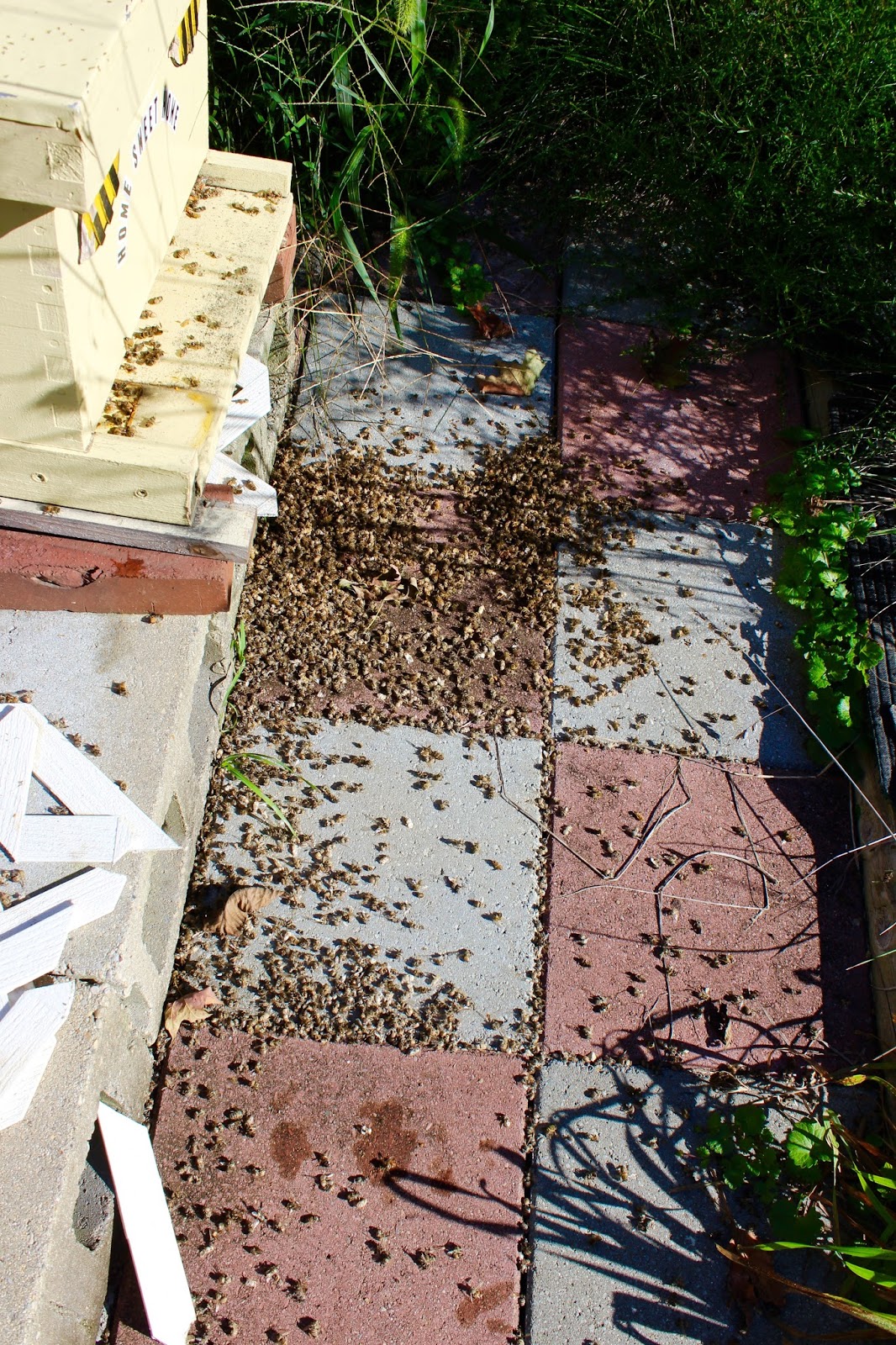
On my last post, I wrote that I'd had thousands of my honeybees die in just a couple of days time. I spoke with an experience beekeeper about the situation. Nectar Dearth would not have caused that many deaths in just a two day span. All indicators point towards the resident across the road who illegally sprayed herbicides on my land a second time, because a three inch tall weed grew under his mailbox, which is on my land.

I spoke to the wife after the first incident. She refused to let me talk with her husband, but had admitted to the spraying. I asked her to stop the spraying as it was not their land, and I grow organically.

Why would he do such a thing? Many Americans have become extremely selfish, believe the world revolves around them, and nobody else matters.

The previous residence who were neighbors to me, allowed me to pull into the beginning of their driveway when a vehicle was behind me. This allowed the vehicle to pass by, and allowed me to safely back into my driveway. When the property was sold, a little over a year ago, the new residence (I cannot call them neighbors), did not see the safety aspect of this situation. They didn't want me to do this, so I stopped, but this man thinks it's okay to spray Round-Up a second on my land, killing my honeybees as it drifted in the air.
Another view of dead honeybees,
many hundreds more are not shown.
Photo by Tracey R. Simmons
September 2016

A great eye-opening article was published in the magazine - Mother Earth News. It was the June/July 2016 issue. The title of the article is - Are GMOs Toxic? An Interview with Genetic Engineer Thierry Vrain.

In this article, it states despite repeat application of glyphosates, weeds continue to adapted and grow. American soil that has been been sprayed with these chemicals is damaged - the microorganism in the soil that gives life is damaged.

Did you know - "Glyphosate was invented as a descaling agent because it binds to all sorts of minerals and makes them unreactive, stripping them from pipes." - (from the article mentioned above)? It was to descale or strip mineral deposites off industrial pipes and boilers. Now it is used on your food, to include being used as a "drying agent" for grains and seed, so after it is repeatly sprayed on the crops in the field, it is then used to dry it. It is on the cereal, beans, sunflowers, etc. that are not organic you, your children, and grandchildren are eating.

Americans need to wake up to the poisonous affects pesticides and herbicides, in particular Glyphosate, contain and the effects of GMO crops on their health, and the affects on the honeybee. Europeans are so much smarter by not allowing GMO crops to be grown.


Saturday, September 17, 2016

Honeybee Hive Dying?

My hive with two large super boxes, and one
medium super (honey super).
Photo by Tracey R. Simmons 2016
One of my heart's desires is to be a beekeeper. Unfortunately for me, all it has been is - trying to be a beekeeper. After moving my hive location further away from the road early this past spring, I thought the problems that was causing my hives to die would be solved.

When I put my package bees into the hive, I saw amazing things I'd never seen before - it was truly a working hive. The queen was laying lots of brood (baby bees), and the worker bees were doing the jobs they are supposed to do. Food was being stored in the frames, with nearly all ten frames filled in the first super box allowing me to put on the second super.

In July, the second super was nearly full, and I worried about the bees swarming. This happens when they run out of room, so I put on a honey super, which is a medium sized box. I put in six frames that had comb already drawn out, and four that just had foundation for the bees to use to draw out the comb. The six frames had to be cleaned first.

Two weeks later, I checked the hive. There was lots of bees, and there was still food stored, but the honey super had no honey being stored, but the comb had been cleaned. I wasn't concerned.
Bees hanging on front.
Photo by Tracey R. Simmons 2016

I left the hive alone for nearly a month. The week before Labor Day, there were lots of bees hanging on the front of the hive - outside. This is no big deal. They will do this when it is hot. A few days later, I found hundreds, probably into the thousands of bees lying in front of my hive - dead.
Hundreds into the thousands of
dead honeybees.
Photo by Tracey R. Simmons 2016

Early that Sunday morning, while it was still cool enough to check the hive, I suited up and walked to to the hive, with all my tools. Without using smoke, I took off the outer cover - no bees. I removed the inner cover to reveal the honey super - no bees. I pulled off the honey super, and the second super box was nearly empty. My heart was beating wildly by this point.

I attached the frame holder to the side of the super, and started working frames loose, pulling them out, and sitting them in the holder. Once I could see through to the super below, I saw few bees - all my hopes were dashed.

The words of the guy who had taught the beekeeping classes, and who had helped me once he found out, two years ago, the struggles I was having, echoed in my ears - "I won't consider you a beekeeper until you have surviving hives." I felt like a failure once again.

Pulling off the second super, I started looking through the first super's frames. I wanted to find the queen, which I did. I didn't find brood, and all food was nearly gone.

There is a situation called nectar dearth in which there is little food for the worker bees to collect, but I had flowers blooming. Maybe it wasn't enough. Maybe the sudden deaths were caused when the residence across the road, decided to spray Round-up on their land, and on my land by the roadway. Yes, that's right - my land! Land I pay a mortgage on. Round-up is known to kill honeybees, yet it is allowed to stay on the market, which is maddening to beekeepers.

Despite my knowing that the chances this hive will make it through the winter would take a miracle, I made sugar water for the surviving bees. It would take twenty-one days before worker bees would emerge as adults ready to work - if the queen started laying right away, knowing food was available.

This past Wednesday, I changed the sugar water, to the sugar syrup, which is thicker. Having done this before, I know the bees would be better off, since there is little time left before winter. I figured I would do the most I could do to help this hive, even though the reality dances around in my head. I also prayed. Miracles can and do happen, even in today's world!

Saturday, September 3, 2016

Pumpkin Plants and Chickens


Pumpkin bloom
Photo by Tracey R. Simmons 2016
Last summer, I had a volunteer pumpkin plant start just outside the chicken pen. The previous fall, I had given my hens an organic pie pumpkin I’d grown. (Pie pumpkins are smaller and meater than carving pumpkins.) It was a tasty treat they enjoyed pecking at and eventually eating. Obviously, they had flipped seeds around, with one seed landing just outside their fenced area.

As fall turned into winter, with lots of heavy snows, that one seed lay frozen to the ground. The life within that seed waited for the mounds of snow to melt, and the warmth of spring to come. As can happen in the Midwest, the cold of winter lingered. Finally, spring came according to the calendar, but not in temperatures.

When the ground and air did warm, I notice the beginning growth of the “volunteer” pumpkin. It was an accident, but good can come from accidents. I had read that squash could be grown vertically if given the right support, so I let the pumpkin grow. The pumpkin’s vines slowly reached up towards the sun, sometimes attaching itself to the fence on its own, and at other times I helped attach it. As those vines reached, they snaked their way up the fence and over the chicken-wired top.
This year's two pumpkin plant growin well, until...
Photo by Tracey R. Simmons 2016


I had planned to put a tarp over the top of the chickens’ pen during the summer, to give the hens shade. The huge leaves of the pumpkin plant became that shade, like multiple little umbrellas providing relief from the sun’s heat. In addition, I didn’t have to do any weeding. That plant provided eight flavorful pumpkins.

Since pumpkins are in the squash family, they can be stored for a period of time. I was able to give the hens a pumpkin every few weeks throughout the winter. This was a nice treat; and it helped relieve some of the winter boredoms for the hens, since they can’t do a lot of scratching in the frozen ground.

When I broke open the pumpkins for the chickens, I saved some of the seeds, and deliberately tossed seeds just outside the chicken pen. I wanted to duplicate what had started as an “accident.”

A baby pumpkin growing above the the chicken coop fence.
Photo by Tracey R. Simmons 2016
This past June, of all the seeds I tossed out, one pumpkin plant started growing on the south facing fence, near my Honeysuckle plant. A second plant started growing on the west facing coop fence about a month later.  The first plant was growing nicely up the fence and over the top, and even had some baby pumpkins growing. 

About this time, I decided to integrate the young pullets with the older hens. I knew the pullets would be laying soon and wanted them to use the bigger hen house with nests to lay their eggs.

I had protected the Honeysuckle plant from the Wyandottes by placing cardboard inbetween them and the fence, with the plant on the outside. With the pumpkin plants, I didn't have to protect them, because the Wyandotte hens left them alone.

If you have read previous post, you know that back in March, Black Australorps and Rhode Island Reds chicks became the newest residents. The Rhode Island Reds are considered good foragers. I found out, by another accident, just how good they are at foraging. 

After playing referee for a few days to keep fights between the older and young chickens to a bare minimum, everyone started getting along fairly well. Then, the youngsters found as few pumpkin plants leaves growing inside the fenced area. The older hens had left them alone, but with the youngsters, their foraging skills went to work quickly. 

To say they were like little lawn lmowers or weedeaters is an understatement. Those young pullets grabbed, chewed, and munched on the pumpkin leaves and moved to the vines. They stuck their heads through the chainlink fence and chowed down on the main vines. 

By the time I realized what was happening, the girls had nearly severed both main vines. The plants' vines and leaves out of the chickens reach no longer had a viable source of nutrients and water. The only thing I could do was watch as the leaves, which had been providing shade, slowly wilted away. 

Out of accidents, either good or bad can come from it. It can also be an opportunity to learn. You can learn from the animals, as the Bible says in Job. I have learned from my chickens. Next spring, I will start pumpkin plants, again, outside the coop fence. I will allow it to grow up and over to provide shade & food, but I will protect the plants from my little munching chickens!