Weddings are the last thing beekeeper Huck Anderson wants to be associated with, considering his past. So when he inherits a building occupied by a bridal boutique, he aims to evict the failing business and open a sporting goods store. Until his tenant ends up being Arianne Winters, a woman he’s indebted to from a mistake made years ago.
When a life-threatening injury derails Huck entirely, Arianne offers a compromise to keep her boutique, and her life, out of bankruptcy—she’ll aid in his lengthy recovery if he’ll allow her to remain in his building. But nursing her adversary proves challenging when her adolescent crush resurfaces.
Amidst a battle-of-wills, their lives intertwine in unexpected ways, providing opportunity to overcome their pasts and start anew. Will this confirmed bachelor consider holy-matrimony, or will Huck’s choices sting them a second time?
Publisher: White Rose Publishing 2016
My Review: I was privileged to read this book prior to it being published. As I am working to be a beekeeper, I loved the honeybee facts at the beginning of each chapter.
I was drawn into the story quickly, and thoroughly enjoyed it. Candice is able to "paint a scene" with her words, so the reader is able to create a movie in their mind. The hero and heroine are realistic; and you will easily be able to identify with their lives. In addition, you will fall in love with Arianne's little girl - Emma, who chips away at the wall in front of Huck's heart.
Find a comfortable reading spot, settle down, and enjoy this book. You will not be disappointed. I give it Five Paws Up.
(I use "Paws Up" instead of stars or thumbs up for my rating scale. Five Paws Up is the best rating.)
A blog about books, animal rescues, country living, and how God teaches through nature.
Saturday, October 29, 2016
Saturday, October 15, 2016
Organic Peanut Butter Helps With Dog's Nail Trimming
![]() |
| Organic Peanut Butter on a Spoon. Paws 4 Hearts Photo 2016 |
Spritzer Nala has white nails, which makes trimming easier, because I can see the pink quick, and avoid it. When a dog is struggling, kicking, crying, and flipping her head this way and that, about the time I'd see the nail, get the clipper over it, ready to trim, that foot has moved, and I've lost the chance to trim that nail.
I found one way that worked - give Spritzen Nala natural dental chews, but it took two per foot. That was a lot going into her belly, so I had to find another way.
![]() |
| A Stress-free Spritzen Nala O'Chi snuggled in her favorite blanket. Photo by Tracey R. Simmons October 2016 |
An "Ah-haa Moment" came when I remembered how dogs love peanut butter. I buy organic peanut butter, which I refrigerate. Cold peanut butter is firmer - you have to let it sit at room temperature for a litte bit to get it to spread on bread. This means it will take longer to lick it off a spoon.
At last, a healthy, stress free solution for dog nail trimming - they lick peanut butter off a spoon, while you trim quickly. The only thing is you can't just lay the spoon on the floor - it will scoot away as they try to lick. If you don't have another human to help, you will have to hold the end of the spoon in your mouth. As the dog licks the peanut butter, you can trim. This may seem like a goofy thing to do, but it does work. You and your dog will have a much lower stress level.
Note: as the peanut butter warms, you and the dog maybe wearing some of it, but that's just a small problem compared to a dog whose nails are too long. Happy trimming!
Saturday, October 1, 2016
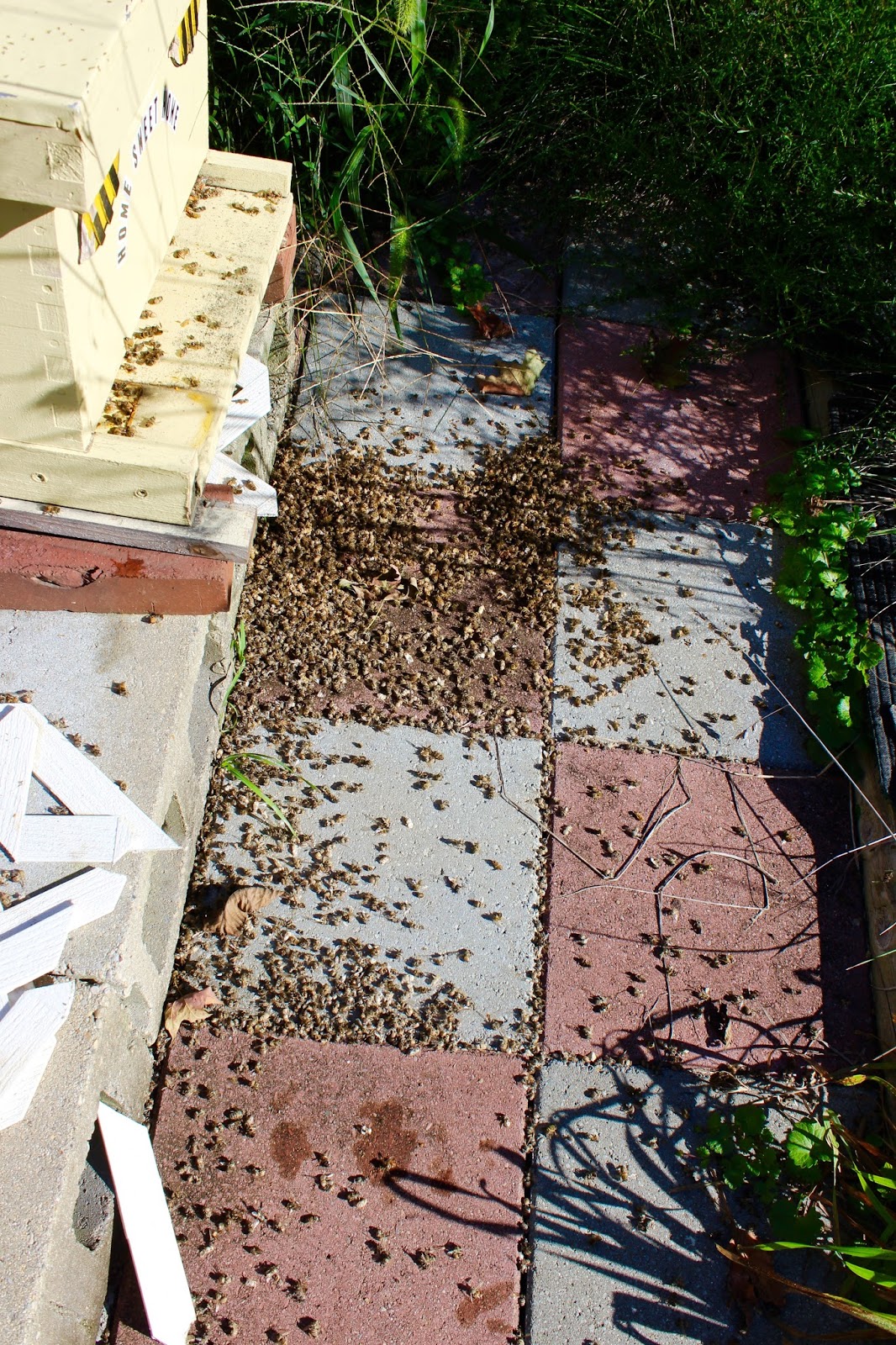
Honeybee Deaths Point Toward Glyphosate Product Spraying
![]() |
| Thousands Of DEAD Honeybees. Photo by Tracey R. Simmons September 2016 |
I spoke to the wife after the first incident. She refused to let me talk with her husband, but had admitted to the spraying. I asked her to stop the spraying as it was not their land, and I grow organically.
Why would he do such a thing? Many Americans have become extremely selfish, believe the world revolves around them, and nobody else matters.
The previous residence who were neighbors to me, allowed me to pull into the beginning of their driveway when a vehicle was behind me. This allowed the vehicle to pass by, and allowed me to safely back into my driveway. When the property was sold, a little over a year ago, the new residence (I cannot call them neighbors), did not see the safety aspect of this situation. They didn't want me to do this, so I stopped, but this man thinks it's okay to spray Round-Up a second on my land, killing my honeybees as it drifted in the air.
![]() |
| Another view of dead honeybees, many hundreds more are not shown. Photo by Tracey R. Simmons September 2016 |
A great eye-opening article was published in the magazine - Mother Earth News. It was the June/July 2016 issue. The title of the article is - Are GMOs Toxic? An Interview with Genetic Engineer Thierry Vrain.
In this article, it states despite repeat application of glyphosates, weeds continue to adapted and grow. American soil that has been been sprayed with these chemicals is damaged - the microorganism in the soil that gives life is damaged.
Did you know - "Glyphosate was invented as a descaling agent because it binds to all sorts of minerals and makes them unreactive, stripping them from pipes." - (from the article mentioned above)? It was to descale or strip mineral deposites off industrial pipes and boilers. Now it is used on your food, to include being used as a "drying agent" for grains and seed, so after it is repeatly sprayed on the crops in the field, it is then used to dry it. It is on the cereal, beans, sunflowers, etc. that are not organic you, your children, and grandchildren are eating.
Americans need to wake up to the poisonous affects pesticides and herbicides, in particular Glyphosate, contain and the effects of GMO crops on their health, and the affects on the honeybee. Europeans are so much smarter by not allowing GMO crops to be grown.
Saturday, September 17, 2016
Honeybee Hive Dying?
![]() |
| My hive with two large super boxes, and one medium super (honey super). Photo by Tracey R. Simmons 2016 |
When I put my package bees into the hive, I saw amazing things I'd never seen before - it was truly a working hive. The queen was laying lots of brood (baby bees), and the worker bees were doing the jobs they are supposed to do. Food was being stored in the frames, with nearly all ten frames filled in the first super box allowing me to put on the second super.
In July, the second super was nearly full, and I worried about the bees swarming. This happens when they run out of room, so I put on a honey super, which is a medium sized box. I put in six frames that had comb already drawn out, and four that just had foundation for the bees to use to draw out the comb. The six frames had to be cleaned first.
Two weeks later, I checked the hive. There was lots of bees, and there was still food stored, but the honey super had no honey being stored, but the comb had been cleaned. I wasn't concerned.
![]() |
| Bees hanging on front. Photo by Tracey R. Simmons 2016 |
I left the hive alone for nearly a month. The week before Labor Day, there were lots of bees hanging on the front of the hive - outside. This is no big deal. They will do this when it is hot. A few days later, I found hundreds, probably into the thousands of bees lying in front of my hive - dead.
![]() |
| Hundreds into the thousands of dead honeybees. Photo by Tracey R. Simmons 2016 |
Early that Sunday morning, while it was still cool enough to check the hive, I suited up and walked to to the hive, with all my tools. Without using smoke, I took off the outer cover - no bees. I removed the inner cover to reveal the honey super - no bees. I pulled off the honey super, and the second super box was nearly empty. My heart was beating wildly by this point.
I attached the frame holder to the side of the super, and started working frames loose, pulling them out, and sitting them in the holder. Once I could see through to the super below, I saw few bees - all my hopes were dashed.
The words of the guy who had taught the beekeeping classes, and who had helped me once he found out, two years ago, the struggles I was having, echoed in my ears - "I won't consider you a beekeeper until you have surviving hives." I felt like a failure once again.
Pulling off the second super, I started looking through the first super's frames. I wanted to find the queen, which I did. I didn't find brood, and all food was nearly gone.
There is a situation called nectar dearth in which there is little food for the worker bees to collect, but I had flowers blooming. Maybe it wasn't enough. Maybe the sudden deaths were caused when the residence across the road, decided to spray Round-up on their land, and on my land by the roadway. Yes, that's right - my land! Land I pay a mortgage on. Round-up is known to kill honeybees, yet it is allowed to stay on the market, which is maddening to beekeepers.
Despite my knowing that the chances this hive will make it through the winter would take a miracle, I made sugar water for the surviving bees. It would take twenty-one days before worker bees would emerge as adults ready to work - if the queen started laying right away, knowing food was available.
This past Wednesday, I changed the sugar water, to the sugar syrup, which is thicker. Having done this before, I know the bees would be better off, since there is little time left before winter. I figured I would do the most I could do to help this hive, even though the reality dances around in my head. I also prayed. Miracles can and do happen, even in today's world!
Saturday, September 3, 2016
Pumpkin Plants and Chickens
![]() |
| Pumpkin bloom Photo by Tracey R. Simmons 2016 |
Last summer, I had a volunteer pumpkin plant start just
outside the chicken pen. The previous fall, I had given my hens an organic pie pumpkin I’d grown. (Pie pumpkins are smaller and meater than carving pumpkins.) It was a tasty treat they enjoyed pecking at and eventually
eating. Obviously, they had flipped seeds around, with one seed landing just
outside their fenced area.
As fall turned into winter, with lots of heavy snows, that
one seed lay frozen to the ground. The life within that seed waited for the
mounds of snow to melt, and the warmth of spring to come. As can happen in the
Midwest, the cold of winter lingered. Finally, spring came according to the
calendar, but not in temperatures.
When the ground and air did warm, I notice the beginning
growth of the “volunteer” pumpkin. It was an accident, but good can come from accidents. I had read that squash could be grown
vertically if given the right support, so I let the pumpkin grow. The pumpkin’s
vines slowly reached up towards the sun, sometimes attaching itself to the
fence on its own, and at other times I helped attach it. As those vines
reached, they snaked their way up the fence and over the chicken-wired top.
![]() |
| This year's two pumpkin plant growin well, until... Photo by Tracey R. Simmons 2016 |
I had planned to put a tarp over the top of the chickens’
pen during the summer, to give the hens shade. The huge leaves of the pumpkin
plant became that shade, like multiple little umbrellas providing relief from
the sun’s heat. In addition, I didn’t have to do any weeding. That plant
provided eight flavorful pumpkins.
Since pumpkins are in the squash family, they can be stored
for a period of time. I was able to give the hens a pumpkin every few weeks
throughout the winter. This was a nice treat; and it helped relieve some of the
winter boredoms for the hens, since they can’t do a lot of scratching in the
frozen ground.
When I broke open the pumpkins for the chickens, I saved
some of the seeds, and deliberately tossed seeds just outside the chicken pen.
I wanted to duplicate what had started as an “accident.”
![]() |
| A baby pumpkin growing above the the chicken coop fence. Photo by Tracey R. Simmons 2016 |
This past June, of all the seeds I tossed out, one pumpkin plant started growing on the south facing fence, near my Honeysuckle plant. A second plant started growing on the west facing coop fence about a month later. The first plant was growing nicely up the fence and over
the top, and even had some baby pumpkins growing.
About this time, I decided to integrate the young pullets with the older hens. I knew the pullets would be laying soon and wanted them to use the bigger hen house with nests to lay their eggs.
I had protected the Honeysuckle plant from the Wyandottes by placing cardboard inbetween them and the fence, with the plant on the outside. With the pumpkin plants, I didn't have to protect them, because the Wyandotte hens left them alone.
If you have read previous post, you know that back in March, Black Australorps and Rhode Island Reds chicks became the newest residents. The Rhode Island Reds are considered good foragers. I found out, by another accident, just how good they are at foraging.
After playing referee for a few days to keep fights between the older and young chickens to a bare minimum, everyone started getting along fairly well. Then, the youngsters found as few pumpkin plants leaves growing inside the fenced area. The older hens had left them alone, but with the youngsters, their foraging skills went to work quickly.
To say they were like little lawn lmowers or weedeaters is an understatement. Those young pullets grabbed, chewed, and munched on the pumpkin leaves and moved to the vines. They stuck their heads through the chainlink fence and chowed down on the main vines.
By the time I realized what was happening, the girls had nearly severed both main vines. The plants' vines and leaves out of the chickens reach no longer had a viable source of nutrients and water. The only thing I could do was watch as the leaves, which had been providing shade, slowly wilted away.
Out of accidents, either good or bad can come from it. It can also be an opportunity to learn. You can learn from the animals, as the Bible says in Job. I have learned from my chickens. Next spring, I will start pumpkin plants, again, outside the coop fence. I will allow it to grow up and over to provide shade & food, but I will protect the plants from my little munching chickens!
Saturday, August 20, 2016
Josh Bleill's Book: One Step At A Time, Good/Bad Medical Care, War Trauma, PTSD, and Child Abuse Trauma
I just finished reading the book, One Step At A Time by Josh Bleill with Mark Tabb. I read
this book, because I’d served in the military, and wanted to know what our
military personnel are dealing with in the war zones since 9/11.
In 2006, Josh was a Lance Corporal in the Marine Reserves in
Indiana. His was called to active duty to serve in a combat zone. In
Fallujah, Josh was severely injured by an IED. He sustained traumatic
amputation of both legs above the knee, and traumatic brain injury (TBI).
The blast injured his buddy - Tim Lang, and killed follow Marines/friends
Joshua Hines and Brock Babb.
John 15:12-13 This is My commandment: that you love one
another [just] as I have loved you. No one has greater love [no one has shown
stronger affection] than to lay down (give up) his own life for his friend.
(Amplified Bible)
Joshua Hines and Brock Babb, and all the other U.S. military
men and women over time, who have given their lives for the sake of democracy
and freedom have shown that greater love. I am grateful for their scarifies,
and their families scarifies. Democracy and freedom are not free and shouldn’t
be taken for granted. We have it at the cost of military members spilled blood
causing loss of life or being maimed for life.
The Marines, soldiers, sailors, and airmen who have been
maimed for life have to find a “new normal” in order to go on with
life. Josh Bleill had to find a new normal, and writes about this in his book.
I read his book with various emotions, not because the book was not good. On
the contrary, this book is quite good, and I feel it should be required reading
for all U.S. citizens and those wanting to become citizens, starting at the high school level on up, because, again,
freedoms like free speech is not free. (I also feel that all should watch the
movie: Taking Chance to include the
Extras the DVD offers.)
Just a few weeks after the Iraq war started in 2003, while
at work, I sustained severe life changing injuries for which I receive
extremely poor medical care. Despite the media stating the U.S. has the “best
health care,” I can certainly say it is not
the best health care after the various forms of negative treatment I
encountered by medical personnel, the lack of care and treatment – injuries
never fixed, the fourth orthopedic doctor - a major sports team doctor who told
me repeatedly, “It was a very complicated injury. I couldn’t fix it all…” yet
none of his reports states this – causing more negative treatment; and what I
still deal with because the damages is now a life time sentence.
I also suffered harassment in the workplace while on what
was supposed to be light duty that contributed to further injuries. These are
the reasons I read Josh’s book with varying emotions.
Josh wrote about the medical care he received, which seemed
so positive and caring – the exact opposite of what I encountered. While
reading, I couldn’t help but wonder where I’d be now if I’d received proper and
caring medical treatment. (I will mention that about two-thirds of the way
through his book, Josh did write about a negative encounter with a doctor - not
one treating him, but one treating his buddy, Tim Lang; and Josh stepped up for
his buddy, letting the doctor know he was out of line. Good for you, Josh. I
wish I’d had a friend like you step up for me.)
Josh had to find that new normal when it came to dealing
with being a double leg amputee. Josh stated, “Getting hurt isn’t supposed to
stop you, it only makes you work harder to get back in the game.”
That game is LIFE
and living it, but there are great challenges to those who deal with leg(s) or
arm(s) amputation or lose of use despite it still being attached. Josh couldn’t
have a job which required standing all day long. There is pain, as well as
fatigue from standing, balancing, and walking on prosthetics.
My upper extremity was not amputated by the injuries, but I
did ask for my hand to be cut off. Amputation wouldn’t stop the neurological
pain and various symptoms the neurological condition causes, but it would stop
the orthopedic pain and more. The doctor wouldn’t amputate. I believe it was because
it would have meant admitting the orthopedic injuries were not all fixed.
Recently, I was asked how do I deal with it all. I answered,
“I don’t have any choice, but to deal with it.” I realized later this wasn’t an
answer, so here is the real deal from those of us with severely damaged
extremity(ies) or amputated extremity(ies.) We deal with it day-by-day, hour-by-hour, and sometimes
minute-by-minute. For me, I talk to God a lot. Those talks include raw,
truthful emotions, even anger. We also learn to fake it until we can make it.
We find a new normal, and get on with
our lives as best we can, and adapting. Because so much is taken away, we work to find new dreams to dream
which give us hope. For me since, I no longer have the leather tooling and piano playing and more abilities, I work towards my dream of being a published writer.
Josh informs the reader how great the obstacles are for
those injured when it comes to finding a job. I understand this all to well. I wanted
and needed to work, not just for a paycheck, but for the emotional well being
too. When it comes to upper extremity disabilities, finding work is difficult.
After losing a good paying job, it took over six and a half stressful years to
get regular employment. It isn’t full time or high dollars, but it is a job I
am grateful for, and when that call came in, I couldn’t help but cry tears of
joy and thanksgiving. This job keeps groceries in the fridge, and has lowered
the stress I felt with needing to keep a roof over my head and utilities paid.
There is nothing extra for driving to do volunteer work, or vacations, Internet,
fancy phones, cable TV, etc., but I have been able to make my “farm” a farm
again after losing my horses (because of the injuries and lost income.) I have
found a love for chickens; and with my eight new hens now laying eggs the Little Bit of Paradise Farm is once again
a farm and not just a place in the country.
I had (have) to find ways to do daily living things that
come easy for other, such as tying shoes. A person does not know just how much
the hands are used, until you lose the use of one. How do you shower, put on deodorant,
dress – pull up your pants, zip & button clothes/coats, or cook, wash dishes, clean,
fold clothes, mow the lawn, etc. or drive a stick shift truck in the middle of
winter with one hand? How do you open jars? I know, but I had to figure it out all
on my own.
I have had well meaning people try to give advice on
how to do something, but don’t realized that when they say, “You could do it
like this” they are actually still using both hands until I tell them to look
at themselves. In addition, there are others who don’t understand what I call
“body mechanics.” They think because my disabled hand is on the lawn mower
handle, snow shovel, or rake handle that I must be using it. No, I do this for
balance reasons. And what I deal with can’t be fixed by “doing more therapy” as
some of said.
Josh writes about the support of his family and friends
during his long recovery. He mentions that Tim Lang also had the support of his
family. Josh wrote, “Family is family.” Unfortunately, that is not the case for
everyone.
Another extremely important subject Josh writes about is Post
Traumatic Stress Disorder (PTSD) that many members of the military who
have been in war zones suffer from. It is not something anyone can understand,
unless they have experienced it.
Before I was injured on the job, I was, once, walking down
the hallway behind two psychology students who were counseling veterans. One
female student joked and laughed to the other about how she showed a military
movie to Vietnam vets and “wonder how many of them would end up under the table.”
I never endured a combat zone, but I did endure another kind
of war – that of abuse within a family. Having come from a majorly
dysfunctional family, where my birth mother and some of her boyfriends were
abusive, I know that not all families are caring and loving. Some are just
people related by blood. My own mother said I “lived in a fantasy world” for
believing that families could love one another and be there for each other. I
do know that it can and does exist - Josh and Tim have it, and many others have
it, as well.
Ephesians 6:4 Fathers (I
believe this should read – mothers and fathers) do not irritate and provoke
your children to anger [do not exasperate them to resentment], but rear them [tenderly]
in the training and discipline and the counsel and admonition of the Lord.
(Amplified Bible)
I believe the above verse speaks of abusiveness by a parent.
When I was a child, I believed greatly in the Bible verse of “obey your mother
and father.” In fact, my birth mother is the one responsible for my siblings
and I starting out in the church – hearing sermons piped into the nursery when
we were babies; but she was “heavy handed” when it came to punishments, and
then it became abusive. Mom used my dad to get a college education, all the
while having affairs, then filing for divorce.
I knew she never wanted custody of us, only taking us after
one man she’d had an affair with, told her he wouldn’t have any respect for
her as a mother if she didn’t take custody of her children. What did he really
know of respect if he was married,
knew my father because of being the farrier for our horses at the time, and who
was having an affair with my mother who was married?
Any kind of abuse can leave scars, but when you’re a child,
like me, living in a war of abuse, where a mother rants and raves for hours,
making you stand or sit there the whole time without saying a word, and who
hits for no reason, or throws things around screaming and cursing, you suffer
trauma to the psyche. There are nightmares and flashbacks, just like war
veterans have. You are different. And as an adult, if you talk about it, people
don’t understand. Some will even say, “Get over it!” They don’t understand that
by talking about it, you are not asking for attention or special treatment, you
are just trying to find answers so you can heal. (And for those who have been
abused, who use what they’ve been through as an excuse to do wrong. It is not a
“Get Out of Jail” free card to do wrong or become abusive towards others.)
To those two psychology students who do not know what a war
zone is like, and who should never counsel people because of their negative
attitudes, and to people who are critical of those who are scarred by child
abuse, it is not that easy to just “get over it.” Unless those who suffer from
war trauma and child abuse trauma are given the tools and help needed, they
don’t know how to get over it. And it is not because they want a pity party by
others. In fact, most will shun themselves from others because of the lack of
understanding and care.
What is needed? What must you and I do?
Love needs to be put into action. Romans 12 verse 9 - [Let
your] Love be sincere: Hate what is evil; but hold fast to that which is
good…verse 14 - Bless those who persecute you [who are cruel in their attitude
toward you]; bless and do not curse them…verse 17 – Repay no one evil for evil,
but take thought for what is honest and proper and noble [aiming to be above
reproach] in the sight of everyone…verse 19 – Beloved, never avenge yourselves,
but leave the way open for [God’s] wrath; for it is written; Vengeance is Mine,
I will repay (requite), says the Lord.
I learned that the hands have more nerves concentrated in
them than any other part of the body, and to greatly appreciate what still works.
What I have learned while reading Josh’s book is that I have to let God take
care of the wrong doings that occurred with the medical treatment or lack there
of; and that sometimes great things can happen after awful things take place.
In conclusion, I will add my thoughts, some which have gone
through my head for quite some time: Babies are not born hating others.
Babies want to be loved. Hate is something that is taught. Families
need to be more than people related by blood. Put away the cellphones &
games, stop the adult partying, and stop thinking of just you (being selfish).
That cellphone/game is not going to be there - to help you if you get injured
or as you age - sitting there alone.
People relationships - family and friends are what we need,
because God made us “social animals.” God made us needing a pack, so to speak.
In other words, we need family, which includes extended family – grandparents,
aunts, uncles, and cousins. And if you find someone who is alone in this world,
make them an “adopted family member”, it will mean more than you may ever know.
Being a family should mean each member is cared about and
loved, as unconditional as humanly possible. Mothers and fathers need to step
up and be parents. Be a positive, loving example and teach, speed time with,
& nurture your child/children. Teaching includes disciplining, but not in
an abusive manner. Teach children to love and give back in a positive way to
this world. Teach manners and respect, not only respect for themselves, but for
others as well, and for our world – the Earth.
If we, the whole earthly population, could do this, we
wouldn’t have another Josh going to war, losing his legs; and we wouldn’t have
children scarred from child abuse.
Please take time to read Josh Bleill’s book One Step At A Time.
****It is also my hope that if one person reading this blog
post is helped, then the difficulty I had writing the truths of my own
experiences will be worth all the pain, both physical (typing is not an easy
task now) and emotional I endured.
When I was a child, there were child abuse laws, and there
were adults who knew of the abuse, yet never reported it. I ask that if you see
or know of any form of abuse to a child, that you report it, and keep reporting
it until something is done to help that child.****
Saturday, August 6, 2016
Newest Chickens Being Named
![]() |
| Pecky Sue Photo by Tracey R. Simmons August 2016 |
“The Hens Nest Inn” newest girls either
have names or will have one when they get a colored leg band on, so that they
can be identified with a particular name. This means, we can’t tell them apart
from the others - Black Australorps or Rhode Island Reds, because they have no
distinguishing markings or personality to set them apart. More names came to
mind or were suggested than we had chicks, so some will be put in reserve for
when new chicks come.
The first to get a name was Pecky Sue,
a Rhode Island Red. There is some old song titled Peggy Sue, which was part of
the inspiration. The other part was this chick liked to peck on me. This
started back in June.
The second to be named was a Black
Australorp whose tail feathers go down rather than up. She was the first of the
Australorps to become friendly – allowing me to pet her and taking food from my
hand. She was first called Onyx, which has now become Onyx O’Peeps, since it
was decided we wanted fun names for the chicks.
![]() |
| Annie Yolkley Photo by Tracey R. Simmons August 2016 |
![]() |
| Annie Yolkley Photo by Tracey R. Simmons August 2016 |
The youngest and smallest Rhode Island
Red chick became Annie Yolkley. She seems to be having bad feather days, or if
it is possible, she has a cowlick in her feathers. Her back feathers don’t lie
over her tail feathers. You can see this in the following two pictures.
![]() |
| Amelia Egghart Photo by Tracey R. Simmons August 2016 |
One Black Australorp’s ear lobes just
recently changed from red to white, so she is Amelia Egghart. She was the
second Australorp to realize being petted wasn’t so bad after all.
![]() |
| Darth Nester Photo by Tracey R. Simmons August 2016 |
That leaves three without a name at
this time, but one of the following will be used: Miss Cluckingsworth, Miss
Eggs-a-lot, Chick Norris, Scarlet O’Henny, Dolly Cluckton, Oprah Peepfrey, or
Peepy Longstocking. I am leaning towards Chick Norris and Scarlet O’Henny for
two of them.
If you have any fun chicken names you
would like to suggest, please leave a comment. Thanks for reading!
Subscribe to:
Posts (Atom)